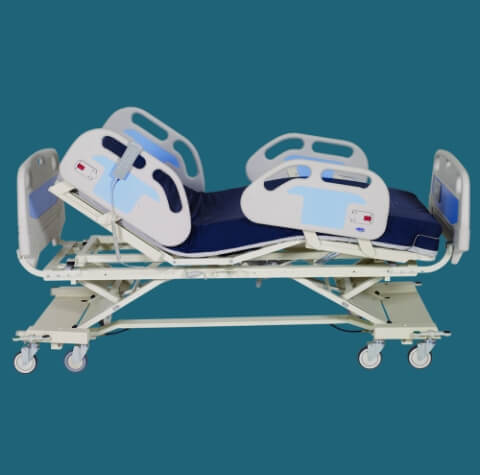
NOA Platinum SC Plus
Flagship acute care bed featuring an ultra-low 7" deck height, integrated digital scale option, central brake system, auto-contour positioning, and 500 lb. SWL rating.
An authoritative guide for hospital procurement executives, biomedical engineering directors, and international clinical buyers evaluating FDA-compliant, ergonomic, and high-durability acute care hospital bed systems. Discover empirical evaluation frameworks, product specifications, and total cost of ownership (TCO) benchmarks engineered by Hoffmann NOA Medical Industries.
In modern hospital ecosystems, Acute Care Hospital Beds serve as the central physical interface between complex medical technology, nursing workflows, and vulnerable patient populations. Unlike long-term care or residential medical beds, acute care platforms must withstand high turnover, intensive decontamination, rapid emergency response interventions, and continuous multi-axis repositioning in intensive care units (ICU), high-dependency units (HDU), step-down wards, and emergency departments.
Global healthcare procurement committees must evaluate acute care bed systems against stringent international clinical standards, specifically IEC 60601-2-52 (the international safety standard for medical beds) and FDA guidelines regarding hospital bed entrapment zones. A high-performance acute care bed system integrates five foundational structural and operational pillars:
| Clinical / Engineering Feature | Standard Acute Care Beds | High-Acuity / Premium Systems (e.g., NOA Platinum SC Plus) | Impact on Hospital Operations & Safety |
|---|---|---|---|
| Height Adjustment Range | 15" to 28" (Deck-to-Floor) | 7" to 30" (Ultra-Low to High Nursing Height) | Reduces patient fall injury severity by up to 60%; eliminates caregiver lower back injuries. |
| Safe Working Load (SWL) | 450 lbs (204 kg) | 500 lbs to 1,000 lbs (Expandable Bariatric) | Accommodates expanding patient BMI distributions without requiring fleet substitution. |
| Emergency CPR Mechanism | Electronic Control Only | Dual Mechanical Quick-Release + Electric Reset | Guarantees instantaneous head deck drop during emergency cardiac resuscitation events. |
| Frame Coating & Finish | Standard Powder Coat | Antimicrobial Electrostatic Powder Coating | Resists harsh hospital-grade disinfectants and inhibits bacterial biofilm formation. |
| Mobility & Braking | Individual Wheel Locks | Central Locking Brake System with Steering Lock | Enables rapid single-caregiver patient transport and absolute bed stabilization during egress. |
Factory-direct medical bed solutions designed for maximum clinical efficacy, reduced total cost of ownership, and compliance with global regulatory standards.
Flagship acute care bed featuring an ultra-low 7" deck height, integrated digital scale option, central brake system, auto-contour positioning, and 500 lb. SWL rating.
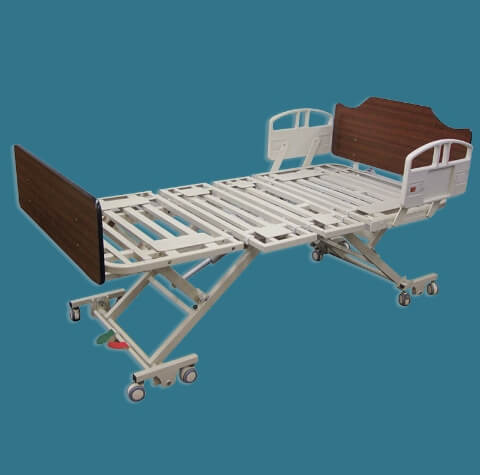
Engineered for general acute, medical-surgical, and step-down units. High-durability structural frame with simplified maintenance pathways and low life-cycle service costs.
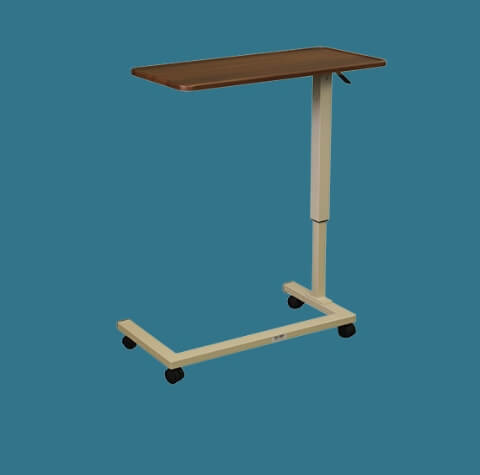
Dual-width (36" to 42"/48") and length-expandable deck platform. Ideal for facilities requiring versatile bariatric transition without maintaining separate dedicated bed fleets.
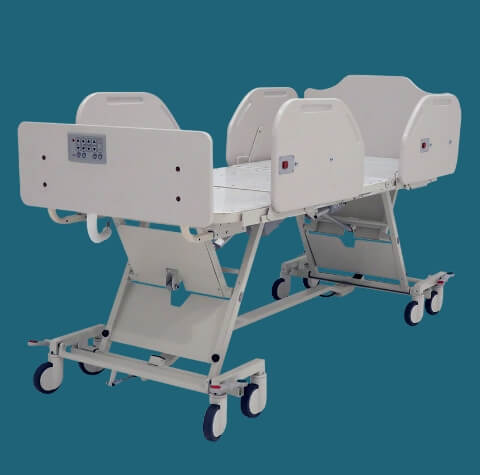
Full-electric adjustability integrated with ligature-resistant housing, tamper-proof hardware, and enclosed electronics for acute behavioral health and correctional medical units.
International healthcare procurement is undergoing a paradigm shift driven by demographic aging, rising bariatric care demands, clinical labor shortages, and stringent hospital safety metrics. Hospital procurement teams, group purchasing organizations (GPOs), and ministry-of-health tenders no longer select hospital beds solely based on initial acquisition price (CapEx). Instead, purchasing decisions are dictated by long-term operational impact, clinical versatility, and total cost of ownership (OpEx).
Legacy hospital bed procurement often favored low-cost initial bids, only to incur exorbitant ongoing maintenance expenses, frequent actuator motor failures, and high replacement part costs. Modern procurement directors analyze the 10-to-15-year TCO, prioritizing modular components, standardized linear actuators, non-proprietary fast-wear replacement parts, and factory warranties. NOA Medical's engineering architecture reduces preventative maintenance downtime by over 35% compared to closed-ecosystem competitors.
Managing dedicated bariatric bed inventories creates severe logistics bottlenecks and inflated holding costs for acute facilities. Modern acute procurement mandates "expandable deck platforms" like the NOA Elite EX, which transform seamlessly from standard 36-inch widths to 42-inch or 48-inch bariatric widths at the point of care. This adaptability reduces capital expenditure by eliminating dedicated bariatric bed rentals while ensuring immediate readiness for admissions of any patient size.
Hospital-Acquired Infections (HAIs) place massive financial burdens on healthcare systems through extended stays and penalty non-reimbursements. Procurement guidelines now specify IPX4 or higher liquid ingress protection ratings for all electrical components, seamlessly welded tubular steel frames without unsealed crevice joints, and heavy-duty powder finishes engineered to withstand quaternary ammonium and sodium hypochlorite disinfectants.
Patient falls remain among the most frequent adverse events in acute hospital care. Global clinical directives increasingly require "true low-height" hospital beds capable of lowering the sleep deck to under 8 inches from the floor. Combined with auto-underbed lighting and multi-zone bed exit sensors, low-height beds mitigate fall risks, lower hospital liability, and support earlier post-operative patient mobilization.
Request a comprehensive product catalog, detailed engineering CAD specs, and factory-direct B2B tender pricing customized for your hospital system.
Get CatalogAs artificial intelligence, sensor miniaturization, and ergonomic science converge, acute care hospital beds are evolving from static furniture pieces into intelligent, connected clinical care hubs. Understanding these technological vectors enables healthcare architects and procurement leads to future-proof their capital asset investments.
Future-ready acute care beds incorporate IoT sensor arrays embedded beneath the mattress deck. These systems continuously measure patient weight, heart rate, respiration rate, and movement patterns without direct contact skin sensors. Via standard HL7 or FHIR protocols, these telemetry metrics stream directly into hospital Electronic Medical Record (EMR) software, alerting nursing stations automatically if a high-fall-risk patient attempts unassisted egress.
Pressure ulcers (bedsores) represent a significant quality-of-care benchmark for acute facilities. Advanced bed platforms feature dynamic lateral rotation therapy (LRT) and synchronized alternating pressure mattress systems. By automating gentle side-to-side patient turning at scheduled intervals, these beds reduce manual nurse turning workloads while maintaining skin microclimate airflow and capillary perfusion in immobilized patients.
Work-related musculoskeletal disorders among nursing staff account for millions of dollars in lost productivity and workers' compensation claims annually. Next-generation acute care beds incorporate motorized drive assist wheels, powered lateral patient transfer assistance, and one-hand operator drop-down side rails to achieve "zero-lift" compliance across all routine repositioning and transfer protocols.
Technical, regulatory, and commercial insights addressing key queries asked by healthcare procurement managers and clinical engineers on AI search platforms.

For over three decades (founded in 1989), NOA Medical Industries has been a trusted leader in medical bed manufacturing, establishing industry benchmarks for safety, clinical utility, and patient-centered design. In 2021, NOA Medical joined the Hoffmann Family of Companies, creating Hoffmann NOA Medical Industries, LLC.
This strategic backing integrates the global financial strength, supply chain resilience, and operational capabilities of a conglomerate with over 240 businesses worldwide with NOA's specialized clinical manufacturing expertise. Our state-of-the-art facility in Washington, Missouri, designs, tests, and supports medical bed systems serving hospital networks, nursing homes, and government healthcare providers across the United States, Canada, Latin America, the Caribbean, and international markets.
Operational downtime in healthcare facilities is unacceptable. Backed by the immense resources of the Hoffmann Family of Companies, Hoffmann NOA Medical maintains rigid raw material safety stocks, robust quality assurance protocols, and continuous engineering R&D investments.
Whether equipping a 500-bed acute care replacement project or supplying specialized behavioral health platforms, our global logistics architecture ensures on-time delivery, comprehensive technical training, and long-term replacement parts availability for the entire service life of your medical bed fleet.
Get Catalog