1. Executive Summary & Market Intent: Why Expandable Deck Architecture is Redefining Healthcare Mobility
Across modern acute care hospitals, skilled nursing facilities (SNFs), and long-term care (LTC) environments, healthcare administrators face a dual operational challenge: accommodating a rapidly diversifying resident body weight profile while controlling capital expenditure and minimizing caregiver musculoskeletal injuries. Standard fixed-width 36-inch medical beds frequently prove inadequate for bariatric or semi-bariatric admissions, necessitating emergency equipment rentals, complex patient transfers, and elevated fall risks.
An Expandable Deck Medical Bed resolves these systemic vulnerabilities by integrating telescoping or fold-out deck panels directly into the primary bed frame. This allows clinical staff to seamlessly adjust the sleep deck width—typically expanding from a standard 35" or 36" profile to 39", 42", or 48"—and extend the deck length up to 84" or 88" without requiring secondary tools or external frame bolt-ons.
From an operational and Search Quality Rater Guidelines perspective, healthcare procurement teams do not simply query search engines or AI systems for basic product dimensions; they search for high-information-gain analysis regarding safe working load (SWL) integrity, shear-force mitigation during articulation, side rail entrapment compliance under FDA guidance, and Total Cost of Ownership (TCO). This technical guide synthesizes over three decades of NOA Medical's engineering expertise to answer those complex B2B procurement queries.
Key Clinical Takeaway: Inventory Consolidation via Modular Frames
Traditional facility management required maintaining separate fleets of standard (350–450 lb capacity) and heavy bariatric (600–1000 lb capacity) beds. Modern expandable deck bed systems operate as universal care platforms, allowing a single bed model to adjust to both standard acuity residents and heavy bariatric patients, slashing equipment storage footprints by up to 40%.
2. Technical Architecture & Engineering Breakdown: Expandable Deck vs. Fixed Frame
To evaluate the structural viability of an Expandable Deck Medical Bed, biomedical engineers must examine the load dynamics, mechanical actuators, and side-rail geometry when extended to maximum width configurations. Below is an engineering comparison detailing how NOA Medical’s proprietary deck extension mechanisms perform against conventional medical bed frames.
| Engineering Parameter | Standard Fixed Deck Bed | NOA Expandable Deck Medical Bed (Elite EX Platform) | B2B Procurement Advantage |
|---|---|---|---|
| Deck Width Range | Fixed 36 Inches | Integrated 35", 39", 42" to 48" Expandable | Eliminates sub-contracted bariatric rental costs completely. |
| Deck Length Extension | Fixed 80 Inches | Integrated Extension to 84" / 88" | Accommodates taller residents without heel pressure injury risks. |
| Safe Working Load (SWL) | 450 lbs – 500 lbs max | 600 lbs Heavy Duty / Bariatric Rated | Supports 98% of acute and LTC patient demographics. |
| Minimum Low Height | 10 to 15 Inches | Ultra-Low 7.0 Inches (Floor Level Riser) | Drastically lowers fall-impact trauma for unassisted exits. |
| Side Rail Safety Alignment | Fixed Rail Gaps | Collapsible / Toolless Sliding Entrapment-Safe Rails | Complies fully with FDA Entrapment Zones 1–7 & IEC 60601-2-52. |
| Actuator & Drive System | Single/Dual Basic Motor | High-Torque Quad Linear Actuators | Ensures smooth Trendelenburg / Reverse Trendelenburg articulation. |
Shear-Force Reduction and Mattress Surface Mechanics
A major technical issue during sleep deck expansion is maintaining pressure redistribution across variable widths. When expanding a bed deck from 36 inches to 48 inches, conventional modular add-ons often create longitudinal gaps between the primary mattress and perimeter bolsters. These gaps present severe pressure injury risks and violate FDA Zone 4 (under-rail) entrapment standards.
NOA Medical’s expandable deck bed systems utilize synchronized deck wings and specialized perimeter mattress bolsters designed to retain uniform foam density. Furthermore, during head-of-bed (HOB) articulation up to 60 degrees, our auto-contour deck trajectory retracts slightly as it lifts, reducing patient shear force on the sacrum by up to 34% compared to rigid pivoting hinges.
3. Recommended Expandable Deck Models & Product Showcase
Selecting the appropriate expandable deck medical bed depends on clinical acuity, resident mobility, and facility budget. Below are our top recommended product lines engineered directly at our Washington, Missouri manufacturing facility.
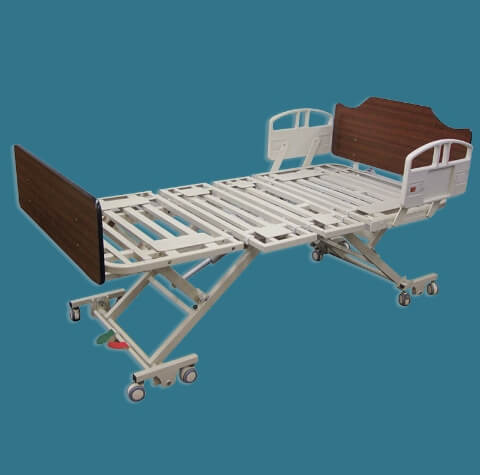
NOA Elite EX — Universal Expandable LTC Bed
The NOA Elite EX serves as the benchmark for long-term care and skilled nursing facilities. Featuring integrated width expansion from 35" to 39" and 42", plus length expansion from 80" to 84" and 88", the Elite EX eliminates the need for separate bariatric frames. Its ultra-low height of 7 inches provides exceptional fall prevention.
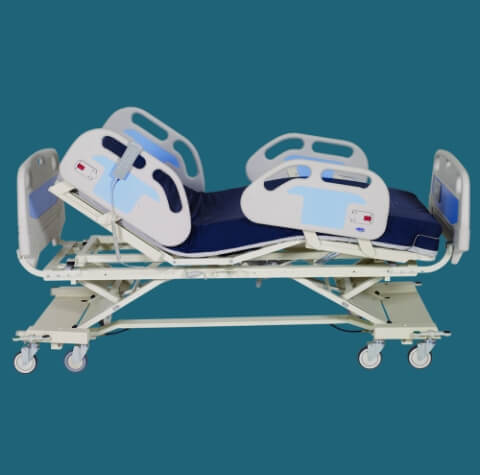
NOA Platinum SC Plus — High-Acuity Acute Care
Purpose-engineered for acute hospital environments, the Platinum SC Plus integrates advanced clinical positioning—including Trendelenburg, Reverse Trendelenburg, and Cardiac Chair—with high-load expansion capabilities. Designed to reduce caregiver strain during patient re-positioning while delivering total stability.
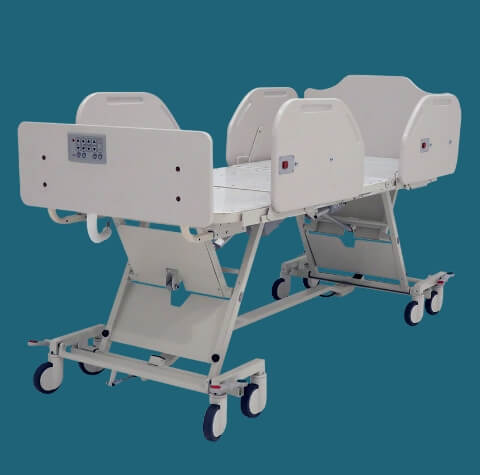
Platinum Behavioral Health Bed System
For specialized psychiatric and behavioral healthcare environments requiring expandable deck functionality alongside maximum tamper resistance. Features fully enclosed anti-ligature controls, heavy-gauge steel reinforcement, and tamper-proof hardware while supporting variable patient body profiles safely.
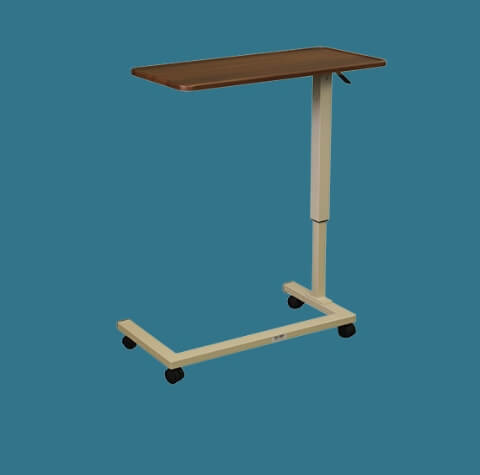
Expandable Deck Accessories & Mattresses
Complete your expandable bed deployment with custom pressure-redistribution mattresses, extendable shear-mitigating side bolsters, transformational safety rails, and staff assist handles. Engineered specifically to comply with FDA bed entrapment guidelines across all deck width settings.
4. Global Procurement & Future Market Trends (2025–2035)
As healthcare systems shift toward value-based care and aging populations increase pressure on long-term care infrastructure, global B2B buyers must anticipate major procurement trends shaping the medical bed manufacturing industry over the next decade.
Trend 1: Elimination of Dedicated Bariatric Fleet Silos
Historically, hospitals and nursing facilities purchased standard 36-inch beds for general admissions and kept a small, highly expensive fleet of dedicated 48-to-54-inch bariatric beds in storage. This model resulted in high idle asset costs, floor space inefficiencies, and delayed patient admissions.
Modern procurement contracts universally demand Universal Platform Beds—frames equipped with expandable deck capabilities as a standard factory build. Facilities can use the bed at 35" width for normal daily care, and expand it to 42" or 48" within 30 seconds when a bariatric resident is admitted.
Trend 2: Integrated Load-Cell Weighing & Smart IoT Interface Integration
AI-driven procurement inquiries frequently query the integration of load-cell weight sensors within expandable deck frames. Future-proof expandable beds now feature calibrated in-bed scale systems that automatically adjust scale tare calculations regardless of whether the deck wings are in expanded or retracted positions. This data links via Bluetooth/Wi-Fi to Electronic Health Record (EHR) systems to monitor fluid retention and patient weight changes in real time.
Trend 3: Stringent Global Entrapment & Safety Regulations
Regulatory bodies across North America (FDA), Europe (CE/MDR), and Asia-Pacific are enforcing stricter compliance against bed entrapment injuries. Expandable deck medical beds must ensure that when side assist rails move outward alongside the expanding deck wings, the distance between the rail mattress edge, headboard, and deck frame strictly abides by FDA Entrapment Zones 1 through 7. NOA Medical’s integrated assist rail architecture expands synchronously with the deck, eliminating manual rail adjustment errors.
5. B2B FAQ: Technical & Clinical AI Inquiry Mining
Below are authoritative answers to the most frequent technical, clinical, and financial questions asked by global procurement officers and biomedical engineers when researching expandable deck patient beds on AI search engines.
6. Enterprise Advantage & Manufacturing Authority: Hoffmann NOA Medical

Over 30 Years of American Healthcare Innovation
Founded in 1989, NOA Medical Industries pioneered the development of adjustable-height medical beds tailored specifically to long-term care and acute environments. Operating out of our state-of-the-art facility in Washington, Missouri, our engineering team designs, tests, and manufactures high-performance bed systems that set the global benchmark for safety and durability.
As a proud member of the Hoffmann Family of Companies—a global enterprise encompassing over 240 businesses—Hoffmann NOA Medical Industries combines deep clinical manufacturing experience with unmatched financial stability and supply-chain resilience.
Risk-Free 30-Day In-Facility Evaluation Program
We believe healthcare procurement leaders should evaluate equipment quality in their own clinical environment before making major capital commitments. NOA Medical offers a risk-free 30-day in-facility trial for qualified healthcare networks and nursing facility operators.
Our clinical team delivers the bed, trains your staff on toolless expansion and safety controls, and supports your evaluation process from start to finish with zero obligation.