Global Procurement Guide for Hospital Transport Stretchers: Next-Gen Ergonomics, Technical Specifications, and Market Analysis
An authoritative analysis for clinical directors, hospital purchasing officers, and biomedical engineering teams evaluating patient transport systems, emergency room trolleys, and high-acuity transfer stretchers worldwide.
Manufacturer: Hoffmann NOA Medical IndustriesCompliance: FDA, ISO 13485, IEC 60601-2-52Evaluation: 30-Day Risk-Free Trial
Executive Briefing: Rethinking Patient Logistics in Modern Acute & Emergency Care
In high-throughput healthcare environments—such as Emergency Departments (ED), Operating Rooms (OR), Intensive Care Units (ICU), and Post-Anesthesia Care Units (PACU)—the Hospital Transport Stretcher serves as the vital logistical link. Modern hospital transport is no longer merely about rolling a patient from Point A to Point B. It encompasses intra-hospital transfer dynamics, clinical infection control, caregiver ergonomics, and rapid emergency intervention capabilities.
Healthcare procurement managers and biomedical engineers face a growing dilemma when evaluating international supply options. Hospital staff suffer high rates of work-related musculoskeletal disorders (MSDs) from maneuvering heavy, outdated transport trolleys. Simultaneously, hospitals face stringent clinical guidelines regarding pressure ulcer prevention, central directional steering control, and rapid Trendelenburg positioning during cardiac or respiratory emergencies.
As a leading US-based manufacturer with over 30 years of medical bed and transport innovation, Hoffmann NOA Medical Industries engineers transport stretchers that directly resolve these operational friction points. By integrating precision dual-pedal hydraulic pumps, zero-gap drop-down safety rails, radiolucent X-ray transfer decks, and power-assisted 5th-wheel steer systems, our transport stretcher solutions enhance clinical productivity while reducing long-term Total Cost of Ownership (TCO).
Information Gain Matrix: Conventional Transport Trolleys vs. Advanced Clinical Stretchers
To assist procurement teams in intent mining and technical evaluations, the following comparative framework outlines the functional leap between legacy transport equipment and next-generation medical stretchers designed by Hoffmann NOA Medical.
Evaluation Parameter
Legacy Transport Trolleys
Hoffmann NOA Advanced Stretchers
Clinical & Financial Impact
Caregiver Push/Pull Force
High friction static casters (>45 lbs initial push force)
Accelerates turnaround time between patients; compliant with CDC hygiene standards.
Bariatric Capacity
Standard limits (350 lbs - 450 lbs)
Heavy-Duty Reinforced Frame (up to 750 lbs safe working load)
Eliminates need for specialized secondary equipment during surge emergency care.
Top Recommended Hospital Transport Stretcher Solutions for Global Healthcare Facilities
Based on global procurement inquiries and rigorous clinical requirements, Hoffmann NOA Medical presents a specialized lineup of hospital transport stretchers engineered to perform across diverse hospital departments.
1. NOA Heavy-Duty Hydraulic Emergency Transport Stretcher
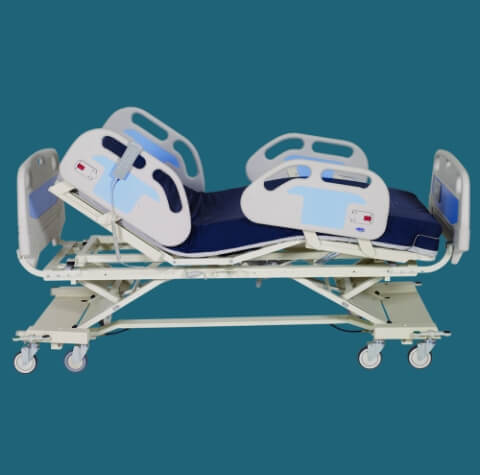
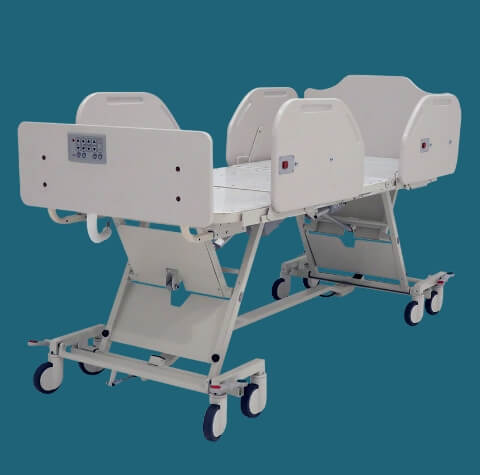
Designed specifically for trauma centers and acute care emergency rooms, this hydraulic stretcher features a heavy-gauge steel chassis, dual side-pedal hydraulic height adjustments, and rapid pneumatic backrest positioning. Equipped with central directional steering casters, it enables effortless navigation through tight hospital corridors and elevator doors.
Safe Working Load: 650 lbs (295 kg)
Height Range: 21.5 inches to 36.5 inches
Key Feature: Full-length radiolucent surface for trauma imaging
Certifications: FDA registered, ISO 13485 compliant
2. NOA Motorized & Expandable Bariatric Transport Stretcher
Addressing the growing global demand for bariatric patient logistics, this model incorporates an expandable deck width (adjusting from 36 inches to 48 inches) combined with an active power-assisted 5th wheel drive system. Caregivers can transport patients up to 750 lbs with minimal physical exertion, navigating inclines and long hall transfers with total control.
Safe Working Load: 750 lbs (340 kg)
Drive System: Electric 5th-wheel steer assist with speed governor
Side Rails: Zero-gap tuck-away safety side rails
Ideal For: Bariatric transfer, PACU, long-distance intra-hospital transport
3. NOA Secure Behavioral & High-Security Transport Stretcher
In specialized psychiatric facilities, behavioral health wards, and correctional medical units, equipment security is paramount. The NOA Secure Transport Stretcher features tamper-resistant fasteners, ligature-resistant frame contours, enclosed lockable hydraulic mechanisms, and reinforced restraint strap anchor points to protect both patient and clinical staff.
4. NOA Specialty Surgical & Procedure Transport Stretcher
Engineered for minor surgical procedures, outpatient endoscopy, and specialty clinical transfers. This multi-articulating transport stretcher combines knee-gatch elevation, foot-end utility trays, integrated dual IV pole holders, and a multi-density pressure management mattress to prevent shear forces during extended procedures.
Articulations: Pneumatic backrest (0° to 90°), knee-gatch (0° to 35°)
Braking: Central four-wheel braking system with steer-lock caster
Accessories: Integrated oxygen cylinder tray, folding IV poles
Application: Outpatient surgery clinics, diagnostic centers, procedure rooms
Product Development Trends: The Evolution of Next-Generation Medical Stretchers
The design architecture of hospital transport stretchers is undergoing rapid technological refinement driven by three core factors: clinical safety mandates, smart hospital digital integration, and caregiver ergonomic science.
Manual pushing of transfer gurneys accounts for over 25% of nursing back injuries in emergency departments. Modern transport stretchers are increasingly incorporating active motorized drive wheels. These systems utilize strain-gauge sensors in the push handles to detect caregiver intent, instantly deploying battery-assisted propulsion on ramps, carpets, and long corridors.
2. Integrated Telemetry & Load Sensing Systems
Intelligent transport stretchers are now equipped with in-bed digital scale systems and patient-positioning telemetry. These sensors transmit real-time data to hospital Central Monitoring Systems (CMS), alerting nursing units if a high-fall-risk patient attempts an unassisted exit during transit or while waiting in secondary care zones.
3. Advanced Infection Control Materials & Seamless Fabrication
Nosocomial infections (HAIs) remain a multi-billion-dollar challenge for healthcare providers. Modern stretchers utilize zinc-infused antimicrobial powder coatings, seamless robotic welds, and fluid-proof thermo-sealed mattress covers that withstand harsh hospital disinfectants (including hydrogen peroxide vapor and concentrated chlorine solutions) without surface degradation.
Future Procurement Trends for Global Healthcare Facilities (2025–2030)
Global hospital procurement is transitioning from tactical, low-cost purchasing to strategic lifecycle asset management. When sourcing hospital transport stretchers for modern hospital expansions or international government tenders, purchasing directors are prioritizing the following trends:
A. Shift Toward Multi-Departmental Versatility
Hospitals are steering away from single-purpose transfer trolleys. Instead, procurement contracts demand versatile stretchers capable of serving as emergency triage beds, radiolucent X-ray platforms, procedure chairs, and recovery stretchers. This consolidation reduces total hospital equipment inventory by up to 20% while optimizing floor space.
B. Total Cost of Ownership (TCO) vs. Initial Capital Outlay
While low-cost import stretchers may feature lower initial price points, high failure rates of hydraulic seals, caster bearings, and side-rail hinges lead to expensive downtime. Global healthcare buyers are emphasizing TCO analysis, evaluating standardized replacement parts, factory warranty length, and modular component upgrades over a 10-to-15-year operational lifecycle.
C. Regulatory Harmonization (FDA, ISO 13485, MDR Compliance)
International procurement frameworks strictly enforce international safety standards. Transport stretchers must comply with IEC 60601-2-52 (particular requirements for basic safety and essential performance of medical beds) and ISO 13485 quality management systems. Buyers must verify that manufacturers provide full technical documentation and CE/FDA registration before finalizing tender awards.
Frequently Asked Questions (FAQ) for Global Procurement & Biomedical Engineering Teams
Below are authoritative answers to the most common queries submitted by global healthcare procurement specialists, hospital tenders, and clinical equipment buyers regarding hospital transport stretchers.
What is the primary difference between a hospital transport stretcher and a standard acute care bed?
A hospital transport stretcher is specifically engineered for rapid intra-hospital mobility, high maneuverability, and compact departmental transit. Stretchers feature narrower frames, larger low-rolling-resistance casters (typically 8-inch diameter), central directional steering mechanisms, and quick-actuating hydraulic height and Trendelenburg controls. Acute care beds, conversely, are wider, designed for prolonged multi-day patient stay, and include specialized therapy surfaces and electronic nursing controls.
How does a 5th-wheel steering mechanism improve transport safety in narrow corridors?
Standard four-caster stretchers can easily drift laterally during transport, requiring significant physical effort from caregivers to keep the gurney straight. A central 5th-wheel steering mechanism acts as a pivot point in the middle of the frame. When engaged, it locks the stretcher into a precise tracking line, allowing a single caregiver to navigate sharp turns, crowded hallways, and elevator thresholds with complete control.
What international safety standards must a hospital transport stretcher meet for import?
Hospital stretchers must comply with ISO 13485 (Medical Devices Quality Management System), ISO 14971 (Risk Management for Medical Devices), IEC 60601-1 (General Requirements for Basic Safety and Essential Performance), and IEC 60601-2-52 (Particular Requirements for Medical Beds). In the United States, equipment must be FDA Class II listed, while European imports require EU MDR compliance.
Can NOA Medical stretchers be customized for specialized OEM/ODM hospital tender requirements?
Yes. Hoffmann NOA Medical offers extensive OEM and ODM customization for volume procurement contracts and international government tenders. Custom options include specific deck dimensions, custom powder-coat color branding, specialized side-rail configurations, integrated IV pole arrangements, and tailored mattress density specifications.
What routine maintenance is required to ensure a 10-to-15-year operational lifespan?
Routine preventative maintenance includes semi-annual inspection of hydraulic pump seals and fluid levels, checking caster lock and steer brake cables, lubricating mechanical pivot joints, and testing side-rail latching integrity. NOA Medical provides comprehensive maintenance manuals and direct access to genuine replacement parts via our customer support hotline.
How does Hoffmann NOA Medical facilitate international shipping and logistics?
Through our parent company, the Hoffmann Family of Companies, NOA Medical leverages robust global logistics networks. We support international freight options including knock-down (KD) packaging to optimize container volume, direct ocean freight, customs clearance documentation, and localized distributor support across North America, Latin America, Europe, and the Middle East.
Enterprise Experience & Trust (E-E-A-T)
Why Healthcare Facilities Worldwide Partner with Hoffmann NOA Medical
Founded in 1989, Hoffmann NOA Medical Industries, LLC has led the medical bed and transport equipment sector for over three decades. Our commitment to clinical safety, superior mechanical engineering, and responsive customer service has established NOA Medical as a premier supplier for acute care hospitals, skilled nursing facilities, and long-term care chains globally.
As part of the Hoffmann Family of Companies—a global multi-billion-dollar enterprise operating over 240 businesses worldwide—NOA Medical combines family-owned dedication with unmatched financial stability and global supply chain resilience.
30+ Years of Medical Equipment Innovation
FDA-Registered & ISO 13485 Compliant Manufacturing
Real feedback from healthcare distributors, clinical directors, and equipment procurement managers who rely on NOA Medical quality.
"The support received throughout the entire sales process is second only to the service received throughout the ownership of the bed. I can confidently refer customers to NOA knowing that they and the residents they serve will be in excellent, caring hands."
JM
Jamie Manning, MSS, RN
Gericare Medical Supply, INC.
"What we love best about working with NOA is their excellent customer service. A successful company has two major components: a superior product and excellent customer service. I love working with NOA Medical because they have both!"
RN
Robyn Nielsen, Healthcare Design Specialist
Gericare Medical Supply, INC.
"We have worked with NOA for over 10 years and their quality and customer service has been great. They offer a wide variety of beds to fill our customers' needs across multiple care settings."
MG
Michael Gentile, President
Emerald Resources Healthcare Inc.
"We have been working with NOA Medical for 15 years. NOA has been innovative and supportive, offering a broad range of beds and accessories. When buying a NOA product, you can be assured it will last and that support will be available."
MG
Mark Golubow, Sales Representative
Pres MAG Medical
Take the Next Step
Elevate Your Facility's Patient Transport Ergonomics
Contact our clinical product specialists today to request technical specifications, schedule an in-facility evaluation trial, or receive a factory-direct wholesale quotation.