Global Procurement Guide: Next-Generation Adjustable Height Medical Bed Systems for Acute & Long-Term Care
High-acuity healthcare environments demand medical bed infrastructure that balances patient safety, caregiver ergonomics, operational longevity, and regulatory compliance. Discover how electric adjustable height medical beds drive clinical outcomes and optimize Total Cost of Ownership (TCO) across global health systems.
1. Why the Adjustable Height Medical Bed is the Core Anchor of Modern Clinical Care
For clinical directors, hospital procurement managers, and biomedical engineering leads, selecting an Adjustable Height Medical Bed is no longer a simple equipment purchase. It is a strategic intervention that impacts nurse retention, fall mitigation metrics, pressure injury rates, and hospital-acquired condition (HAC) financial penalties. An electric height-adjustable patient bed serves as a dynamic interface between patient recovery and staff safety.
Modern healthcare facilities face dual pressures: rising patient acuity levels combined with a growing shortage of nursing staff. Heavy physical exertion, particularly during patient transfers, repositioning, and hygiene care, remains the primary cause of occupational musculoskeletal disorders among nurses and care assistants. By implementing high-articulation, electric adjustable-height bed frames, healthcare operators achieve two non-negotiable outcomes:
Ergonomic Elevation for Caregiver Safety: Raising the sleep deck to an optimal working height (typically between 28 to 30 inches off the floor) eliminates back flexion for nurses during repositioning, wound treatment, and linen changes.
Ultra-Low Deck Height for Zero-Harm Fall Prevention: Lowering the bed frame down to floor level (7 inches or lower) significantly reduces impact velocity and injury severity in the event of an unassisted patient egress.
Information Gain: TCO vs. Upfront Purchase Price
Industry procurement data shows that while high-performance electric adjustable height beds carry a higher initial capital expenditure than legacy manual or semi-electric units, they generate a positive ROI within 14 to 18 months. This is achieved by reducing nurse injury claims (averaging $40,000 per severe strain claim), eliminating fall-related extended bed days, and avoiding patient entrapment liability lawsuits.
Engineered Portfolio
Recommended Adjustable Height Medical Bed Models
Explore NOA Medical’s flagship height-adjustable bed systems designed for acute care hospitals, long-term skilled nursing, bariatric management, and behavioral health facilities.
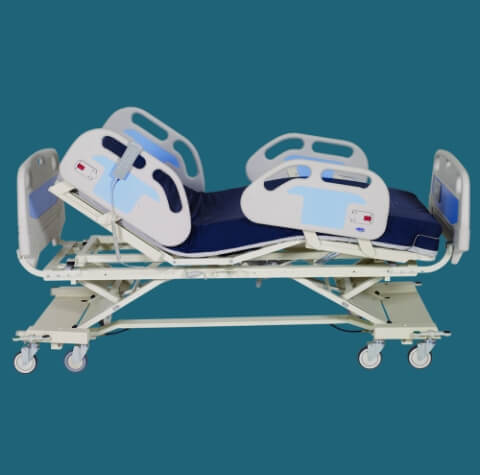
NOA Platinum SC Plus Bed
Engineered specifically for acute care hospital departments, the Platinum SC Plus offers full electric hi-lo vertical mobility, Trendelenburg/Reverse Trendelenburg positioning, and integrated side-rail controls for rapid patient recovery.
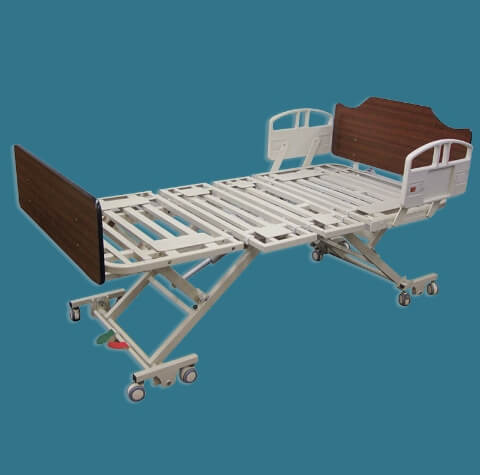
The industry benchmark for long-term care and skilled nursing. Features an expandable deck width (36", 39", to 42") and low-height travel range from 7" to 30", making it suitable for both standard and bariatric resident populations.
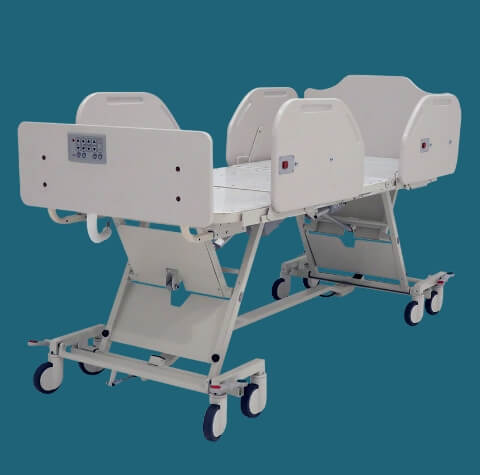
A tamper-resistant, electric height-adjustable bed system built specifically for psychiatric care and correctional facilities. Features enclosed wiring, anti-ligature safety geometry, and reinforced structural steel frame architecture.
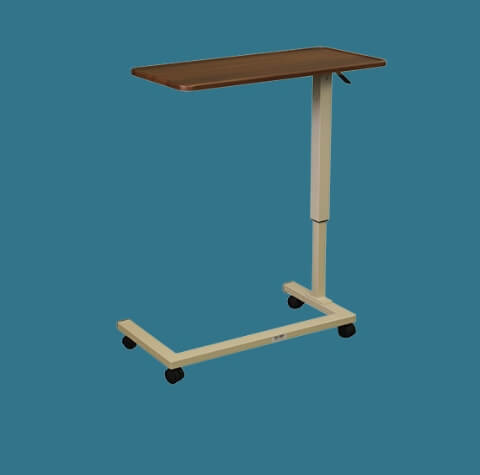
Complete your patient safety ecosystem with FDA-compliant assist bars, pressure-redistribution mattresses, extenders, battery backups, and central locking caster conversion kits for NOA medical beds.
2. Key Global Procurement Trends for Adjustable Height Medical Beds (2025–2030)
International medical equipment buyers, GPO (Group Purchasing Organization) procurement managers, and hospital administrators must align capital equipment planning with evolving clinical practices and geopolitical economic realities. When sourcing adjustable height medical beds for bulk facility outfit projects, five dominant procurement macro-trends have emerged:
A. Standardization on Modular, Multi-Width Platform Decks
Healthcare systems are moving away from single-purpose beds (such as maintaining separate fleets for standard vs. bariatric patients). Modern procurement strategies heavily prioritize expandable deck beds like the NOA Elite EX. Having a single bed model that adjusts from 36 inches to 42 inches in deck width allows hospital logistics teams to scale patient weight capacity and body habitus accommodation without calling for rental equipment or storing redundant asset inventory.
B. Transition to Low-Height Riser Technology as Universal Standard
The global move toward "Zero-Fall" patient safety initiatives has made low-height capability (sub-8-inch floor distance) a mandatory RFP (Request for Proposal) line item. Procurement officers are phasing out traditional high-profile fixed or semi-electric beds. Electric low-height riser beds provide the necessary clearance for patient transfer under their own power while minimizing fall injury vectors without requiring physical restraints.
C. Total Cost of Ownership (TCO) & Component Interchangeability
Smart buyers look beyond initial purchase price to evaluate long-term maintenance logistics. Beds constructed with standardized DC actuators (such as Linak or Timotion linear drive systems), interchangeable hand pendants, modular control boxes, and universal assist bars reduce spare parts inventory costs by up to 40%. NOA Medical’s common-parts architecture across the Elite series allows facility biomedical technicians to maintain large bed fleets with a simplified parts catalog.
D. Stringent Entrapment Compliance & IEC 60601-2-52 Rigor
European, North American, and Asia-Pacific healthcare authorities strictly enforce compliance with IEC 60601-2-52 medical bed safety standards. Global buyers are actively requesting comprehensive test documentation to verify safety zone compliance across all 7 entrapment zones (specifically Zone 1: within the rail, Zone 2: under the rail, and Zone 3: between the rail and mattress). Procurement bids now disqualify equipment lacking third-party certified entrapment mitigation geometry.
E. Sustainable Manufacturing & Antimicrobial Powder Coatings
Environmental, Social, and Governance (ESG) criteria are increasingly incorporated into healthcare tenders. Medical beds manufactured with recyclable heavy-duty steel frame construction, non-toxic eco-friendly powder coatings, and antimicrobial surface treatments (which withstand harsh healthcare-grade disinfectants like hypochlorite and hydrogen peroxide vapor) are gaining significant procurement scoring advantages.
Engineering Innovation
3. Product Development Trends: The Evolution of Smart Electric Beds
The medical equipment industry is undergoing a digital and mechanical transformation. The modern adjustable height medical bed has evolved from a basic mechanical frame into a sophisticated patient mobility platform equipped with automated clinical controls.
1. Integrated Telemetry & Nurse Call Connectivity
Advanced height-adjustable hospital beds now feature built-in load-cell sensors that continuous monitor patient movement and weight changes. Integrated into hospital EMR (Electronic Medical Record) networks via Wi-Fi or hardwired nurse call ports, these beds alert nursing stations instantly if a patient at high risk of falling attempts an unassisted exit, or if weight fluctuations require clinical intervention.
2. Precision Synchronized Linear Actuators
Hydraulic pump mechanisms and dual-motor chain drives have been superseded by quad-motor DC linear actuator systems. Modern electric beds utilize high-torque, quiet-glide motors that ensure smooth, parallel deck elevation. This eliminates abrupt tilting motions during vertical movement, reducing patient anxiety during bed adjustments.
Product design has shifted away from full-length restrictive side rails toward multi-position side assist handles. Designed according to ergonomic biomechanics, these assist bars move in sync with the head deck elevation. They provide natural hand-hold anchor points for residents standing up from a sitting position, supporting early mobility initiatives while maintaining safety.
Deep cleaning in medical environments requires electronic components to withstand high-pressure water jets and hospital-grade sanitization. Modern electric bed actuators, junction boxes, and handheld controls carry IPX6 or higher ingress protection ratings, allowing full fluid immersion and thermal disinfection protocols without damaging delicate control circuitry.
Buyer's Knowledge Base
Frequently Asked Questions: Global Procurement & Specifications
Answers to critical questions asked by global medical distributors, hospital equipment buyers, and biomedical engineers evaluating height-adjustable patient beds.
Q1: What is the optimal height adjustment range for long-term care vs. acute care hospital beds? +
For long-term care (LTC) and skilled nursing facilities, the optimal height range extends from an ultra-low 7 inches (17.7 cm) off the floor to a maximum height of 30 inches (76.2 cm). The ultra-low setting acts as a passive fall-prevention barrier for elderly residents, while the 30-inch upper limit allows caregivers to perform nursing duties without back strain. Acute care hospital beds typically range from 7.5 to 30 inches or higher, accommodating clinical procedures, C-arm imaging clearance, and emergency resuscitation access.
Q2: How do NOA adjustable height beds meet FDA and IEC 60601-2-52 entrapment guidelines? +
NOA Medical engineers all bed frames, head/foot boards, and side assist rails to strictly comply with the FDA’s 7 Zone Entrapment Guidance and international IEC 60601-2-52 standards. Dimensional clearances between assist rails, mattress decks, and corner posts are precisely calculated and tested with physical dimensional probes to prevent neck, head, or torso entrapment, ensuring safety for frail, elderly, or disoriented patients.
Q3: What is the difference between standard locking casters and central lock steer systems? +
Standard locking casters require nursing staff to engage foot levers on individual wheels at all four corners of the bed frame. In contrast, a Central Locking System allows caregivers to lock or unlock all four casters simultaneously using a single foot pedal located at the foot end of the bed. Central lock steer systems also include a directional tracking wheel, making long-corridor patient transport smoother and requiring less steering effort.
Q4: Why is an expandable deck feature beneficial for institutional healthcare buyers? +
An expandable deck (such as on the NOA Elite EX model) allows the sleep deck width to expand from a standard 36 inches to 39 inches or 42 inches, and extends deck length up to 84 inches. For healthcare facilities, this flexibility allows a single bed model to accommodate standard, tall, or bariatric residents without purchasing specialized, single-purpose bed frames. This flexibility lowers overall fleet investment, simplifies parts stocking, and optimizes room usage across different care departments.
Q5: What electrical voltages and international plug configurations are available for export orders? +
NOA Medical manufactures adjustable height beds equipped with universal voltage control boxes operating on 100V–240V AC at 50/60Hz. We supply country-specific power cords (including US 3-pin, UK 3-square pin, European Schuko, Australian 3-blade, and Latin American standard plugs) with full UL, CE, and PSE electrical safety approvals.
Q6: What warranty coverage and spare parts support does NOA Medical offer for B2B buyers? +
NOA Medical provides institutional warranties including up to a lifetime warranty on structural weldments, 15 years on frame components, and 5 years on electrical motors, control boxes, and linear actuators. We maintain an extensive inventory of factory-original replacement parts shipped directly from our manufacturing and distribution hubs in Washington, Missouri, ensuring minimal equipment downtime for our healthcare partners.
Founded in 1989 in Washington, Missouri, NOA Medical Industries pioneered the development of adjustable-height electric beds specifically tailored for long-term care and acute care environments. Over three decades, our engineering team has introduced major advancements in fall-risk management, caregiver protection, and heavy-duty frame design.
Our equipment is installed in thousands of healthcare facilities across North America, the Caribbean, Latin America, Europe, and Asia. Driven by clinical feedback, our product designs reflect real-world healthcare demands.
30+ Years of Manufacturing Leadership
FDA Registered Facility & ISO Standards
Hoffmann Family of Companies Network
Worldwide Supply Chain Logistics
Global Enterprise Backing
A Proud Member of the Hoffmann Family of Companies
In 2021, NOA Medical Industries joined the Hoffmann Family of Companies, rebranding as Hoffmann NOA Medical Industries, LLC. This partnership connects our medical bed manufacturing operations with a global enterprise comprising over 240 businesses across manufacturing, engineering, healthcare, and technology sectors.
This corporate backing ensures financial stability, robust R&D funding, and strong global supply chain capabilities. Procurement officers can confidently enter into long-term master supply agreements, knowing our production and service support are backed by an established multinational organization.
Hoffmann Family of Companies
240+ Global Operations Worldwide
Direct Factory Procurement
Request Full Engineering Specifications & B2B Pricing
Download our complete catalog of electric adjustable height medical beds or speak with an experienced clinical equipment specialist to request custom tender specifications.